Accounting
The reason this is a business tool and not a crypto app.
Taking a stablecoin payment is the easy part. Recording it so that HMRC, your accountant and your future self are all satisfied is the part that has stopped everyone else.
None of this is a monthly import or an end-of-quarter reconstruction. It happens while the customer is still at the counter.
The quarter, closed
The two reports that are usually a fortnight of work.
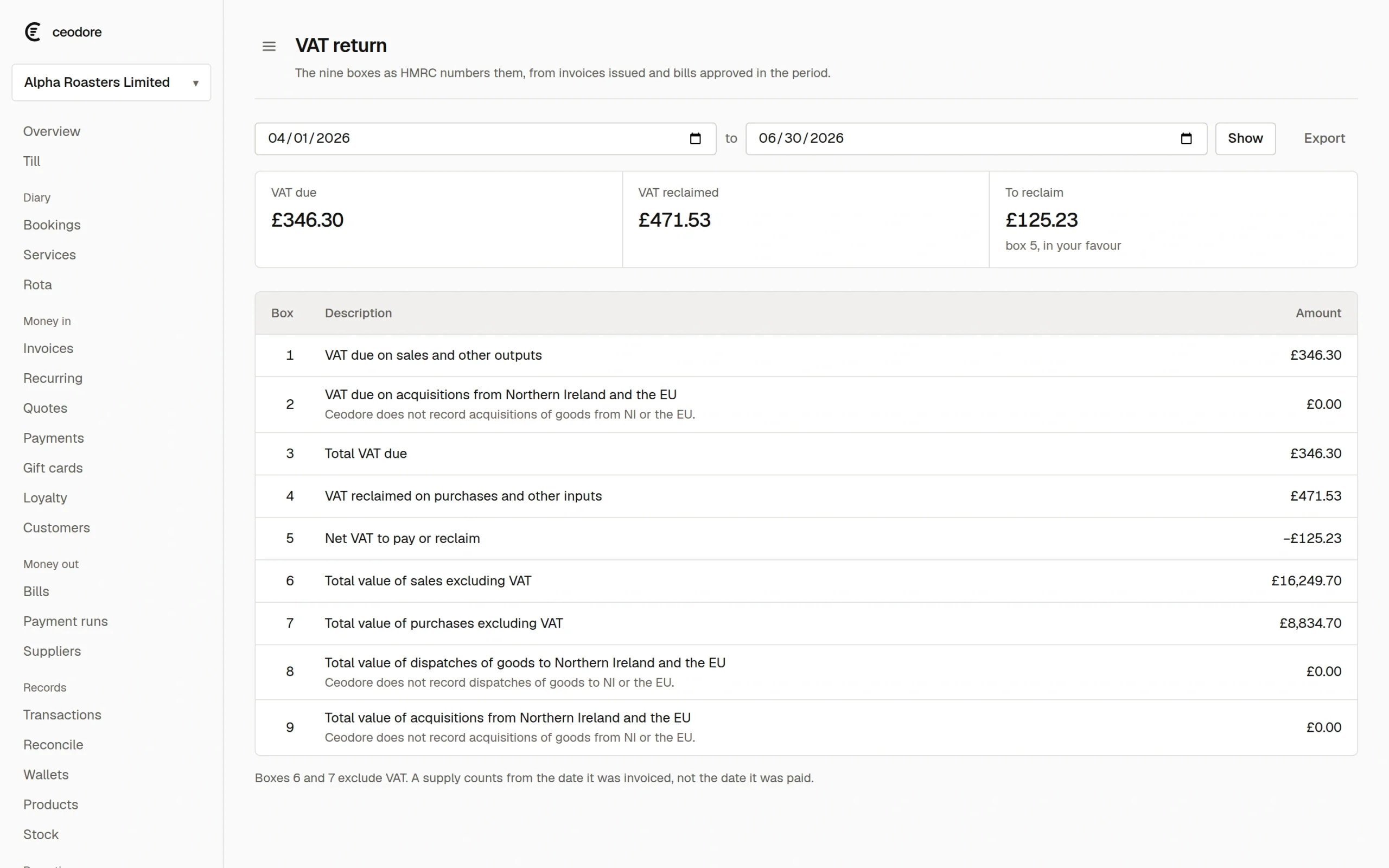
All nine boxes, as HMRC numbers them, across zero-rated coffee and standard-rated servicing and delivery.
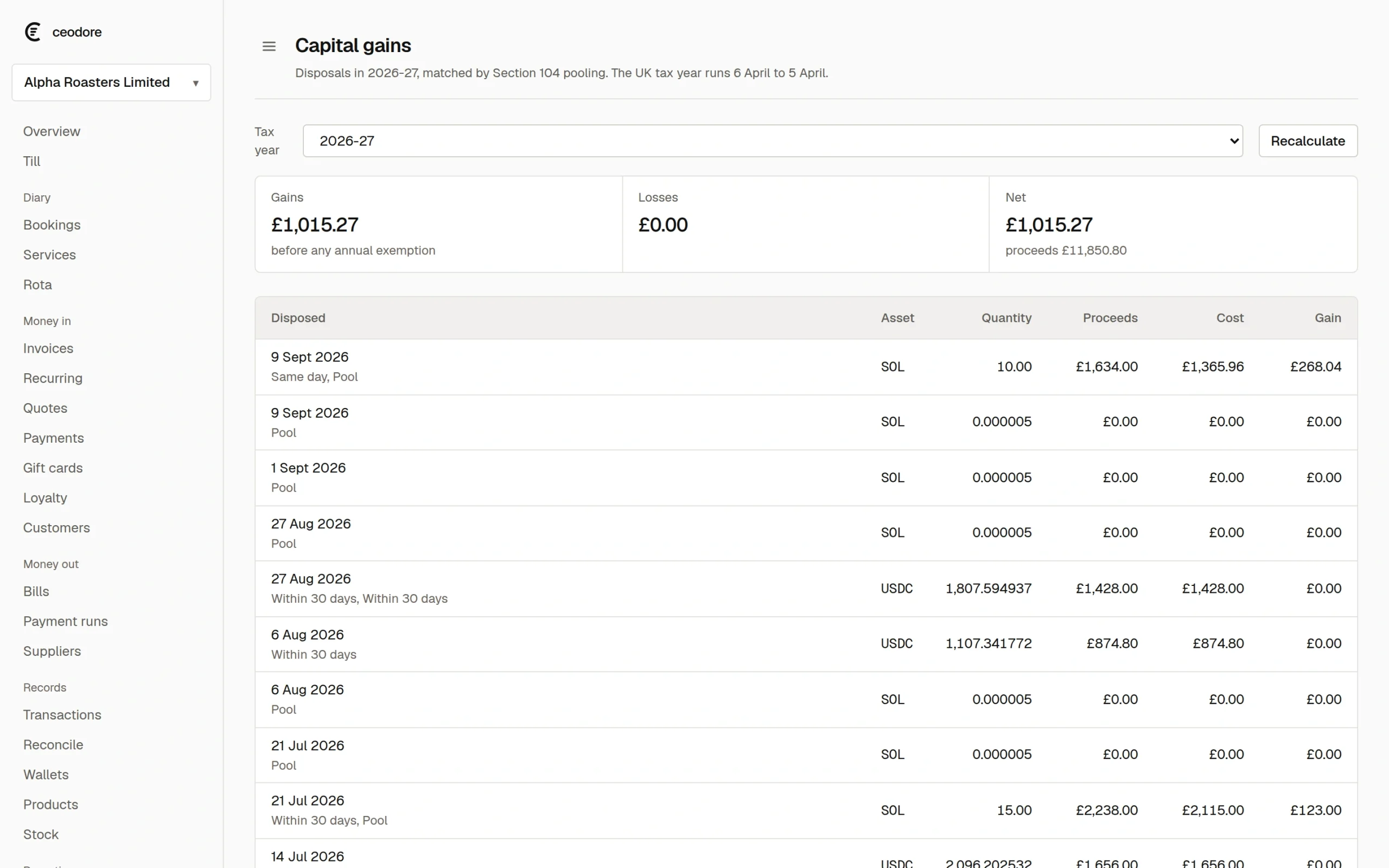
Section 104 pooling, with the same-day and thirty-day rules named against each disposal so you can check the working.
What happens when a payment lands
One tap at the counter, four things recorded.
Immediately
The payment is matched to the invoice or the till sale it belongs to, and to the customer who made it.
At the same moment
Its value is recorded in sterling, at the rate and the timestamp of the transaction. This is the figure VAT is due on, and it cannot be reconstructed accurately later, which is why it has to be captured now.
Behind the scenes
The asset goes into your Section 104 pool at that cost, so any future disposal has a correct basis to work from.
Within the minute
It is categorised against a nominal code and pushed to Xero, where your accountant will find it exactly where they expect it.
VAT
VAT is due on the sterling value of the supply at the time it was made, whatever the customer paid in. Ceodore captures that figure at the moment of the transaction rather than estimating it afterwards.
Your return is prepared from real recorded values, with the boxes filled and an export ready to file.
Capital gains
Holding an asset and later disposing of it is a chargeable event, even when the asset is a stablecoin and the movement is tiny. It still has to be worked out properly.
Ceodore applies Section 104 pooling with the same-day and thirty-day matching rules, on every disposal, automatically. No spreadsheet, no guessing at which units were sold.
Into Xero
Mapped once, and then it just posts.
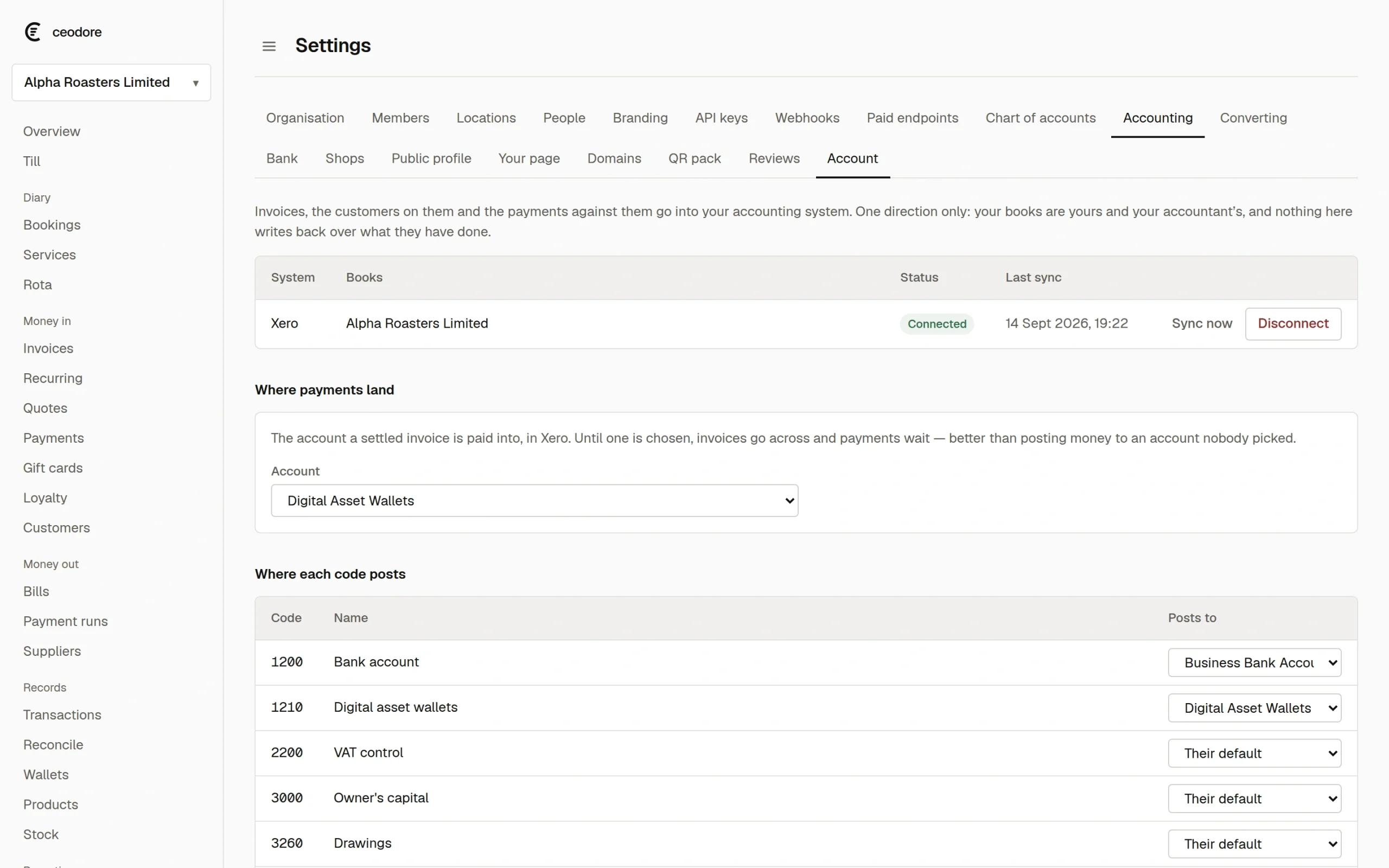
Every nominal code mapped to the Xero code it posts to, with the last sync recorded. Your accountant finds things where they expect them.
The ledger
Names, not addresses.
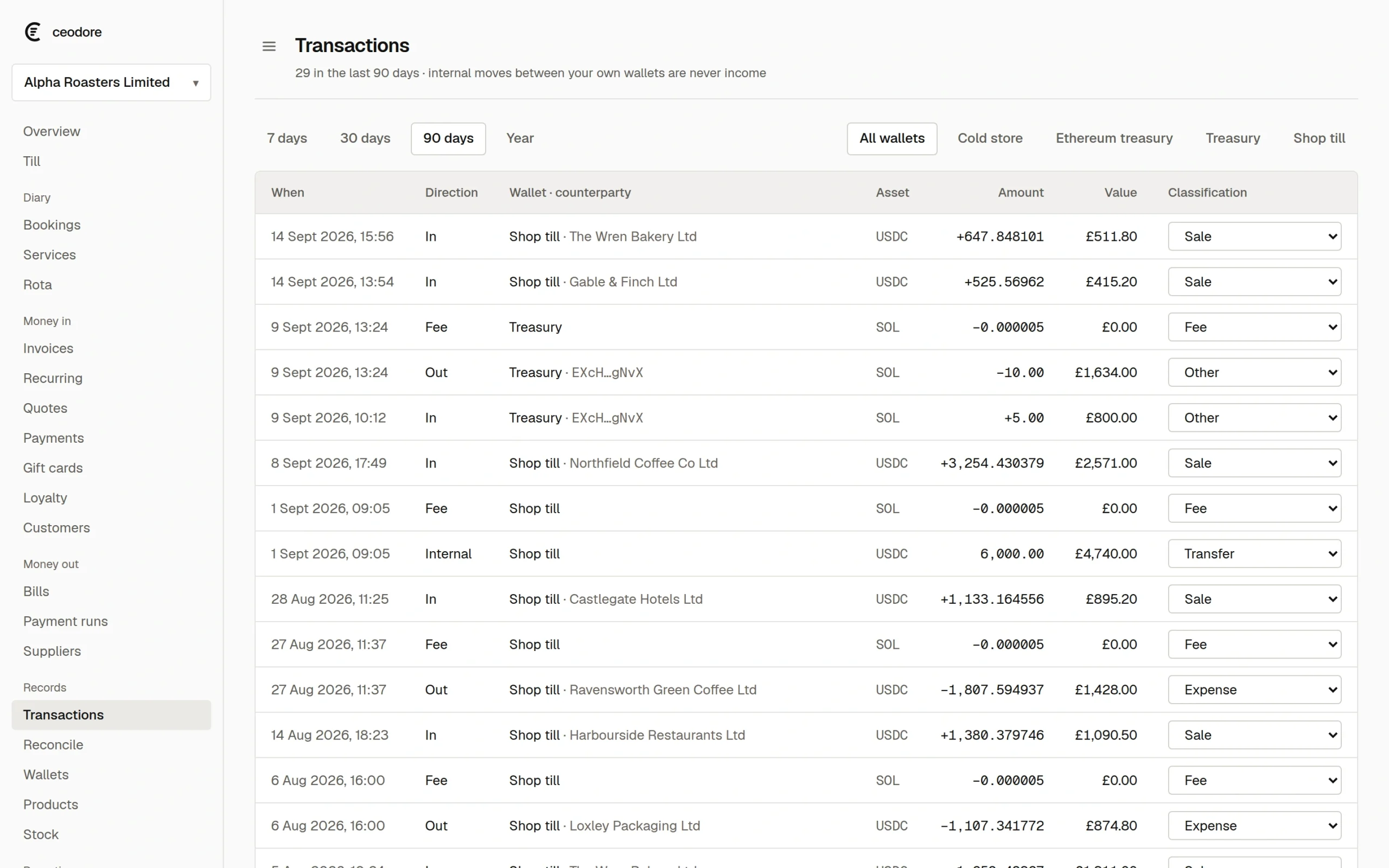
Every entry classified, every counterparty resolved to the customer or supplier it belongs to, and a sterling value beside each amount.
The line marked Internal is a move between the business's own two wallets. It is recorded, and it is never counted as income. That single behaviour is where most crypto bookkeeping quietly goes wrong.
Everything you hold, not just what you took
Your Bitcoin belongs in the same books.
Payments come in on Solana, because that is where they are fast and cheap enough to take at a counter. But a business that holds anything else does not get to keep it out of its accounts, and HMRC does not treat it differently because you never spent it.
Watch what you already have
Add any address you control on Bitcoin, Ethereum or Solana and Ceodore watches it. Balances, movements and sterling valuations, alongside the wallet your till pays into.
Watch-only means exactly that. Nothing is connected, nothing can be spent from it, and we never hold a key to it. It is there so the record is complete.
The same treatment, whatever it is
Section 104 pooling does not care which asset it is applied to. A Bitcoin disposal pools and matches under the same same-day and thirty-day rules as a stablecoin one, valued in sterling at the time it happened.
Transfers between your own wallets are detected as transfers and never counted as income, across chains as well as within one.
Which chain does what
Solana is where payments are taken. Requests, checkout, the till and settlement all happen there, because a payment has to be worth pennies and land in a second.
Bitcoin and Ethereum are watched and valued for your books. You cannot take a counter payment in them today, and we would rather say so than let you find out.
Every chain sits behind the same interface, so adding one is an implementation rather than a second product.
The unglamorous details that matter
The things that break other people's bookkeeping.
Your own transfers are not incomeMoving funds between your own wallets is detected and recorded as a transfer, never counted twice as revenue.
Counterparties get namesOnce an address is known it is named everywhere, so your ledger reads like a ledger rather than a list of hex.
Refunds tie backA refund is linked to the original payment, not left floating as an unexplained outgoing.
Gift cards are a liabilityMoney taken now against goods chosen later. VAT falls when the card is spent, not when it is sold, and the balance sits as a liability until then.
Discounts reduce the VATA promotion reduces the value of the sale, so the VAT is calculated on what was actually charged.
Everything is exportableP&L, balance sheet, transactions, disposals. CSV, spreadsheet or PDF, whenever you want it.
Send this page to your accountant.
They are the one who decides whether this is sensible, and they will have sharper questions than you do. We wrote a page for them.